Integrated Mission – All for One, One for All


For industrial companies to consistently perform at a high level and deliver excellence, it is not enough for departments to agree on a shared mission. Agreement is easy. Alignment is harder. Integration is where performance is won or lost.
Most plants can articulate a shared goal. In nearly every industrial environment, that goal is some version of production output at optimal cost. The challenge is not stating the mission. The challenge is integrating daily decisions, priorities, and activities across departments so that the mission becomes real in how the plant operates.
This is where many organizations struggle.
Shared mission versus integrated mission
A shared mission exists when everyone agrees on what success looks like. An integrated mission exists when each department actively aligns its work with that mission and with the work of the other departments.
In most plants, Production or Operations is the only function directly measured on output. Maintenance is focused on PM and PdM execution, schedule compliance, and responding to breakdowns. Procurement is focused on sourcing parts and managing cost. Engineering is focused on projects, upgrades, and new equipment.
Each department is doing exactly what it has been asked to do. The problem is that these activities often operate in parallel rather than in partnership.
When activities are not integrated, departments unintentionally work at cross purposes. Production pushes for maximum runtime while Maintenance struggles to access equipment. Procurement optimizes part cost while Maintenance absorbs reliability risk. Engineering delivers projects that look good on paper but create long-term maintenance challenges. The mission may be shared, but the work is not integrated.
Integration is where the mission becomes reality
An integrated mission connects the work of every department to the same outcome and to each other.
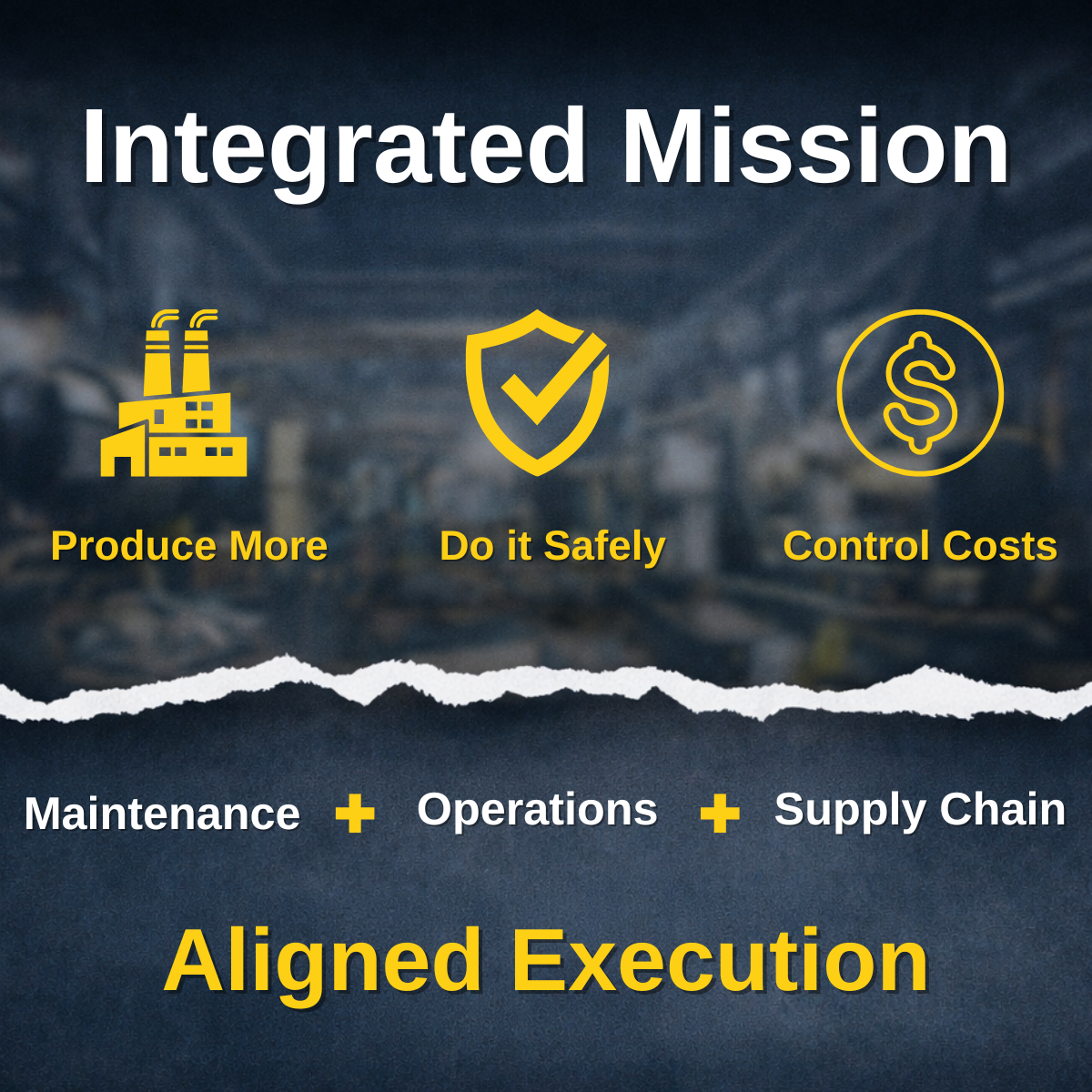
The shared mission remains production throughput at optimal cost. Integration defines how each department supports that outcome in a coordinated and intentional way.
Production contributes through order completion and stable schedule execution. Maintenance contributes through asset uptime and reliability. Procurement contributes through parts availability and supply continuity. Engineering contributes by designing and improving assets so they can be operated and maintained reliably over their full life.
Integration means these contributions are not isolated. Production planning considers maintenance needs. Maintenance planning considers production commitments. Procurement decisions consider asset reliability and lead time risk. Engineering decisions consider maintainability and long-term performance, not just capital cost or project timelines.
Departments understand how their actions affect the system. Just as importantly, they understand how the actions of others enable or constrain their own success.
Building a high-performance foundation
If you want to pursue excellence, start by moving beyond a shared mission and toward an integrated mission. Define not only what the plant is trying to achieve, but how each department contributes and how those contributions connect.
Integration requires discipline. It requires visibility into how work flows across departments. It requires leaders to challenge local optimization and reinforce system thinking. Most importantly, it requires departments to plan and execute together, not just agree at a leadership level.
There is much more required to become a high-performance organization. But without an integrated mission, improvement efforts remain fragmented, conflicts persist, and performance gains are difficult to sustain.
A shared mission sets direction. An integrated mission turns that direction into daily reality.
Align Your Performance
From PM optimization to full asset health assessments, our team helps you identify gaps, align actions, and strengthen reliability.